
What a good AI marketing workflow looks like in practice
Most UK teams don’t struggle with “getting access to AI”. They struggle with turning AI into repeatable marketing output that is (a) on-brand, (b) measurable, (c) safe, and (d) actually used by busy people. The gap between “we tried ChatGPT” and “AI has improved our marketing operations” is rarely technical — it’s workflow design.
A good AI marketing workflow is not a prompt. It’s a system: a set of steps, roles, checks, and feedback loops that turn inputs (briefs, products, performance data, brand rules) into outputs (copy, pages, ads, reports) with clear ownership and quality control. Done properly, it makes marketing more consistent and faster without turning your channels into a slot machine.
This guide shows what that looks like in practice: how to structure the workflow, what to automate first, where human review is essential, and how to measure outcomes without fooling yourself.
One more point that matters: the best workflows are boringly repeatable. They don’t depend on one person “being good at prompts”. They’re designed so the average team member can get a strong output, and the reviewer can validate it quickly. That’s how AI becomes an operational advantage rather than a set of one-off experiments.
Start by choosing the workflow, not the tool
AI marketing projects go wrong when the brief is “use AI for content” or “use AI for ads”. That’s like saying “use spreadsheets for finance” — true, but useless. Instead, pick a specific workflow that already exists in your business.
Examples of workflows that are usually worth fixing first:
- Content production: brief → outline → draft → edit → publish → refresh.
- PPC optimisation: data pull → analysis → hypothesis → changes → monitoring.
- SEO triage: crawl/index checks → prioritisation → fixes → re-check.
- Weekly reporting: metrics → insight → actions → owners → follow-up.
If you’re unsure where to start, an AI audit is the fastest way to map your workflows, assess data readiness, and identify the highest-return first pilot.
The building blocks of a strong AI marketing workflow
In practice, good AI workflows have the same components, regardless of whether you’re using AI for SEO, PPC, social, or email:
| Component | What it is | Why it matters |
|---|---|---|
| Inputs | Brief, product facts, audience, offers, brand rules, performance data | Garbage in = confident garbage out |
| Constraints | Claims policy, tone, do/don’t list, formatting rules | Prevents drift and compliance issues |
| Steps | A repeatable sequence (draft → review → revise) | Turns AI into a process, not a novelty |
| Owners | Who approves what, who publishes, who maintains | Stops “everyone thought someone else did it” |
| Checks | QA rules (links, claims, structure, tracking) | Protects brand and performance |
| Feedback | Performance review + prompt/rules updates | Improves output and reduces waste over time |
A practical example: an AI-assisted content workflow (that editors don’t hate)
Content is the most common entry point for AI, and also the easiest place to create a mess. The goal is not to publish more pages; it’s to publish better pages more consistently. A workflow that works in the real world typically looks like this:
Step 1: Create a brief that’s “AI-proof”
Briefs fail when they are vague. A good brief makes it hard for AI to go off piste. Include:
- Target reader and intent (what they’re trying to achieve).
- One clear angle (what makes this page different from the ten others).
- Mandatory sections (what must be covered).
- Do-not-say list (claims, competitor references, risky phrases).
- Internal links you want to include (3–6 is typically enough).
Step 2: Draft structure first, not the full article
Ask AI for an outline with H2/H3 headings, then review it like a plan. This is the cheapest moment to change direction. Once the structure is right, drafting becomes far faster and more consistent.
Step 3: Draft in sections with a QA checklist
Instead of “write the whole article”, produce the first draft section-by-section. That reduces repetition, improves coherence, and makes it easier to enforce style rules. Your checklist can be short but strict:
- Does it answer the query intent quickly?
- Does it include practical examples?
- Does it avoid filler and generic AI phrasing?
- Are internal links natural and relevant?
For smaller teams, the sweet spot is using AI to create consistent, high-quality drafts and checklists — then humans do the final editorial pass. This is exactly the kind of work that fits AI for small businesses programmes: higher output without hiring a small army.
Step 4: Editorial review with explicit decision points
Editors need to know what they’re judging. A good workflow gives them “gates”, for example:
- Gate A: facts and claims (true? provable? compliant?).
- Gate B: positioning (on-brand? right audience? right angle?).
- Gate C: SEO mechanics (titles, internal links, topical coverage).
Step 5: Publish, then schedule a refresh based on performance signals
AI is excellent at structured refreshes: update sections, add missing FAQs, improve clarity, and strengthen internal linking. The key is not to refresh blindly; base it on signals such as impressions, clicks, conversion rate, and queries showing mismatched intent.
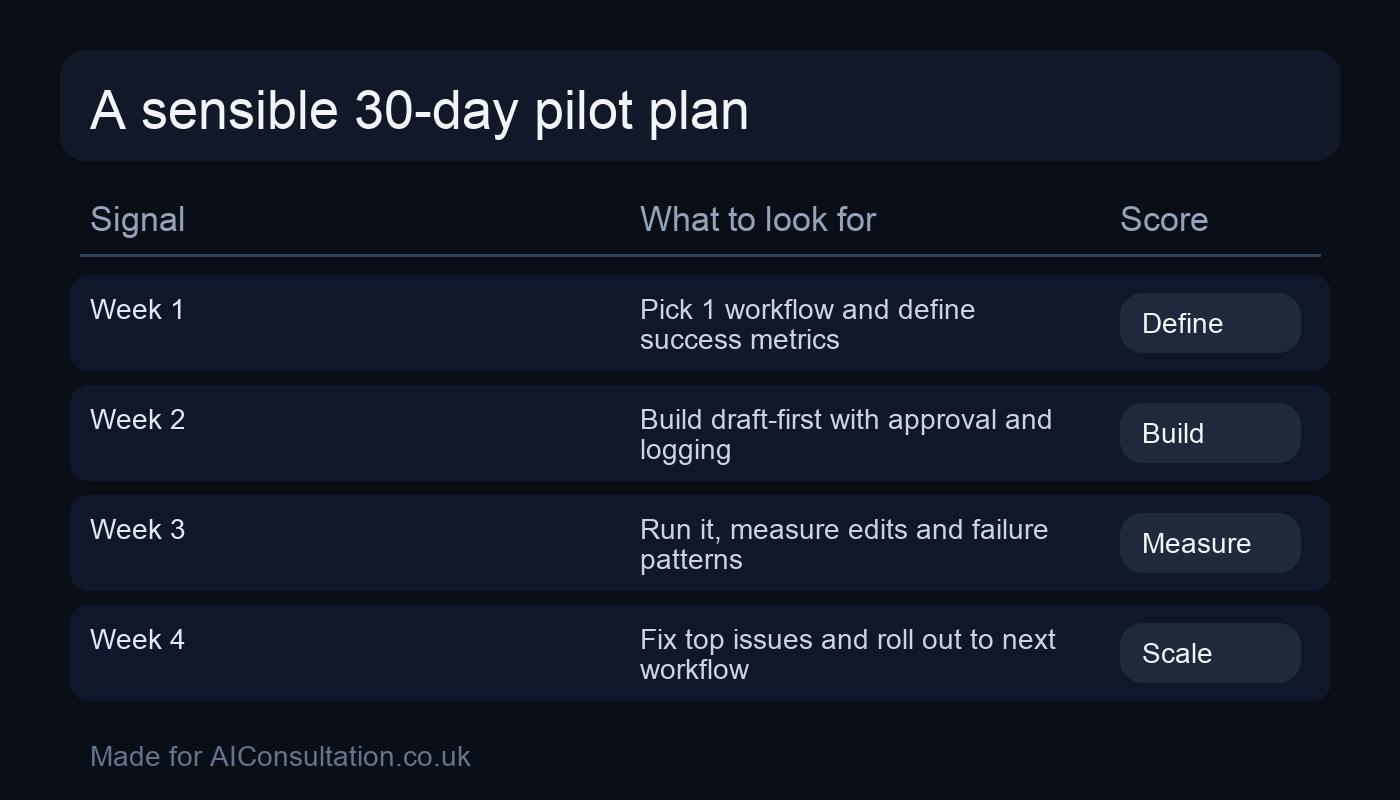
A practical example: AI-assisted PPC workflow (safe, measurable, and repeatable)
PPC is another area where AI can help quickly — mostly because the data is structured and the workflow is repetitive. A good AI PPC workflow doesn’t “let AI run the account”. It uses AI to speed up analysis and improve consistency, with humans approving changes.
| Weekly PPC step | What AI does | What humans do |
|---|---|---|
| Search term review | Cluster queries + flag irrelevant themes + draft negatives | Approve negatives + apply in batches |
| Performance review | Summarise what changed + plausible drivers + suggested actions | Validate tracking + choose top 1–2 actions |
| Creative iteration | Generate variants within a claims policy | Approve copy + run controlled tests |
| Landing page alignment | Spot mismatches between queries, ads, and page content | Decide which fixes actually matter |
If you want a broader, end-to-end delivery approach that covers governance and integration (CRM, analytics, reporting), our AI services can help you put the workflow on rails and keep it maintainable.
The “boring” governance rules that make AI marketing successful
Governance isn’t paperwork — it’s the rules that prevent you from shipping mistakes at scale. You don’t need a 40-page policy to start, but you do need a few clear lines.
- Claims policy: what can be said, what needs proof, what is banned.
- Approval gates: what must be human-approved (ads, pricing, compliance wording).
- Data boundaries: what data can be used (and what must never be pasted into tools).
- Logging: what changes were made, when, and why.
For many UK teams, the compliance side becomes urgent as soon as AI touches customer data or regulated claims. If that’s you, start with AI compliance work before scaling beyond pilots.
A useful rule: if an output could reasonably be screenshot and shared publicly, treat it as “external-facing” and require a human check. That includes ad copy, landing pages, emails, case study claims, pricing statements, and anything that could create a customer expectation. You can still move quickly — but speed should come from better templates and clearer gates, not from skipping review.
Common mistakes (and how to avoid them)
Most failures are predictable. If you avoid these, you’re already ahead of the average “AI marketing initiative”.
- Trying to automate publishing immediately: draft first, publish later, and keep review gates.
- Optimising to the wrong metric: CTR and CPA can improve while lead quality collapses — build quality checks in early.
- Over-producing content: if you can’t review it, don’t generate it. Limit output to what you can publish well.
- Not owning maintenance: prompts, rules, and checks need a named owner and a review cadence.
- No baseline: if you don’t measure time saved or performance impact, AI becomes “busy work”.
How to measure an AI marketing workflow (without kidding yourself)
AI value usually appears in three places: efficiency, effectiveness, and risk reduction. Pick 1–2 metrics per workflow and track them consistently.
Also be careful with “vanity” signals. It’s easy to celebrate that you produced 10 briefs in a day, or generated 50 ad variants — but if your team only reviews and ships two, you’ve created work, not value. A good workflow increases throughput of approved outputs, not throughput of drafts.
| Outcome | Good metrics | Notes |
|---|---|---|
| Efficiency | Hours saved per week; time-to-publish; time-to-report | Measure before and after; keep scope consistent |
| Effectiveness | Conversion rate; qualified leads; revenue per visit | Don’t attribute every lift to AI; look for steady gains |
| Consistency | QA pass rate; fewer errors; fewer “missed” actions | Consistency compounds over time |
| Risk reduction | Fewer compliance issues; fewer incorrect claims | Often the most valuable, least visible benefit |
Workflow templates you can copy (and adapt)
If you want AI to be used consistently, give your team templates. Templates reduce decision fatigue and make reviews quicker. Here are three that work well in practice.
Template 1: The “one-page brief”
- Audience: who is this for?
- Intent: what are they trying to do?
- Angle: what’s our unique point of view?
- Proof: facts, examples, case evidence (and what we must not claim).
- CTA: what should the reader do next?
Template 2: The “weekly performance narrative”
- What changed: the 3 biggest movements.
- Why it likely changed: 2–3 plausible drivers.
- What we’ll do next: 1–2 actions with owners and dates.
- What we’re not doing: items parked (and why).
Template 3: The “AI output QA checklist”
- Is it accurate and on-brand?
- Are claims compliant and provable?
- Are internal links correct and helpful?
- Does it match intent in the first 5–10 seconds of reading?
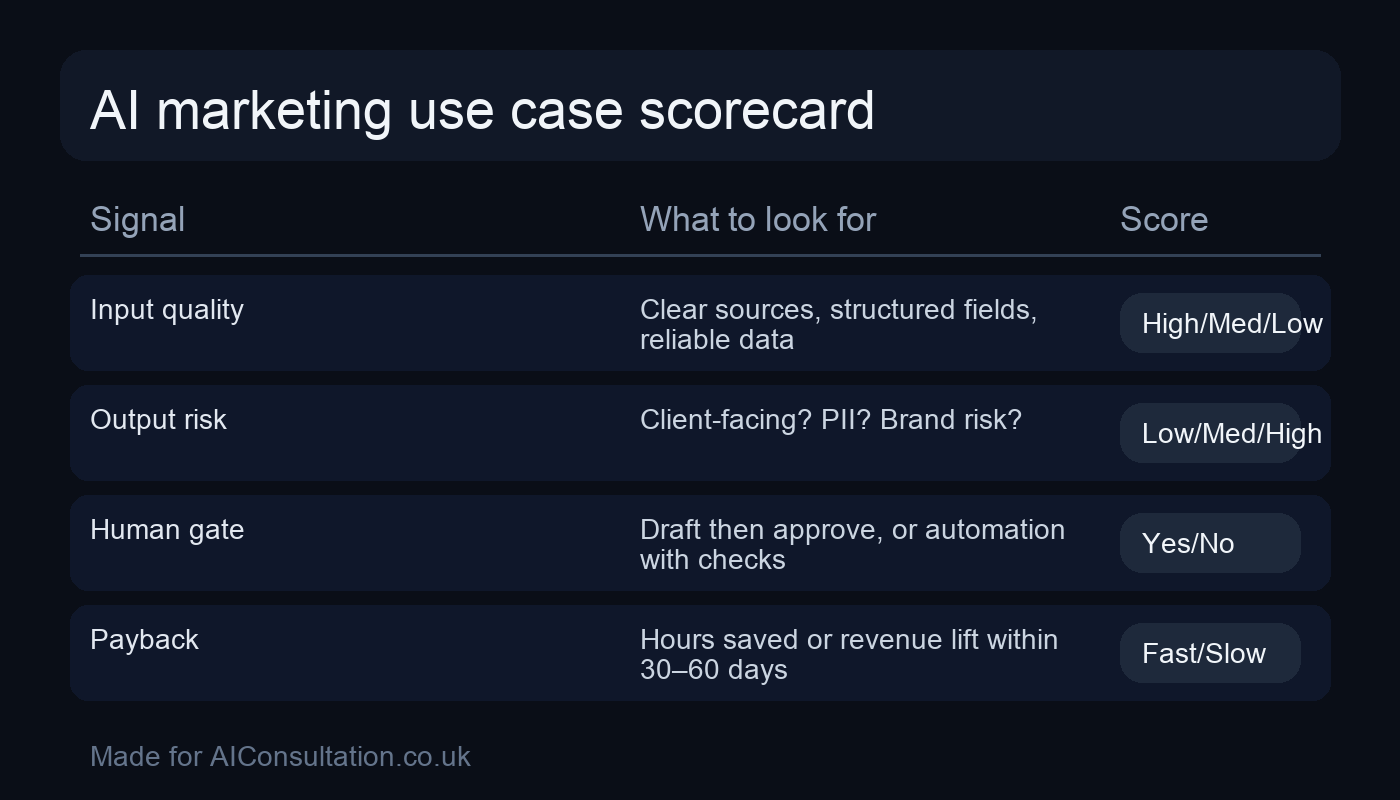
Once templates exist, the workflow becomes easy to teach: new team members can follow the same pattern, and quality improves because reviews become consistent.
FAQs — AI marketing workflows
Do we need a huge content team to benefit from AI?
No. Smaller teams often benefit most because AI removes admin and increases consistency. The key is to keep the workflow tight and measurable.
Should we use one tool for everything?
Usually not. Most businesses do better with a small toolkit plus clear rules — and a workflow that fits existing systems rather than replacing them.
How do we stop the output sounding generic?
Use stronger briefs, require specific examples, and add an editorial review gate. Generic output is a workflow problem more than a model problem.
Can you help us implement this end-to-end?
Yes. We can design the workflow, build integrations, and set governance so it runs reliably. If you want to discuss a pilot, get in touch.
Final checks
- Title has no year and no colon.
- At least 2 internal links included.
- Exactly 1 external link included.
- At least 2 images embedded with clear placement.
- Word count meets the minimum.