
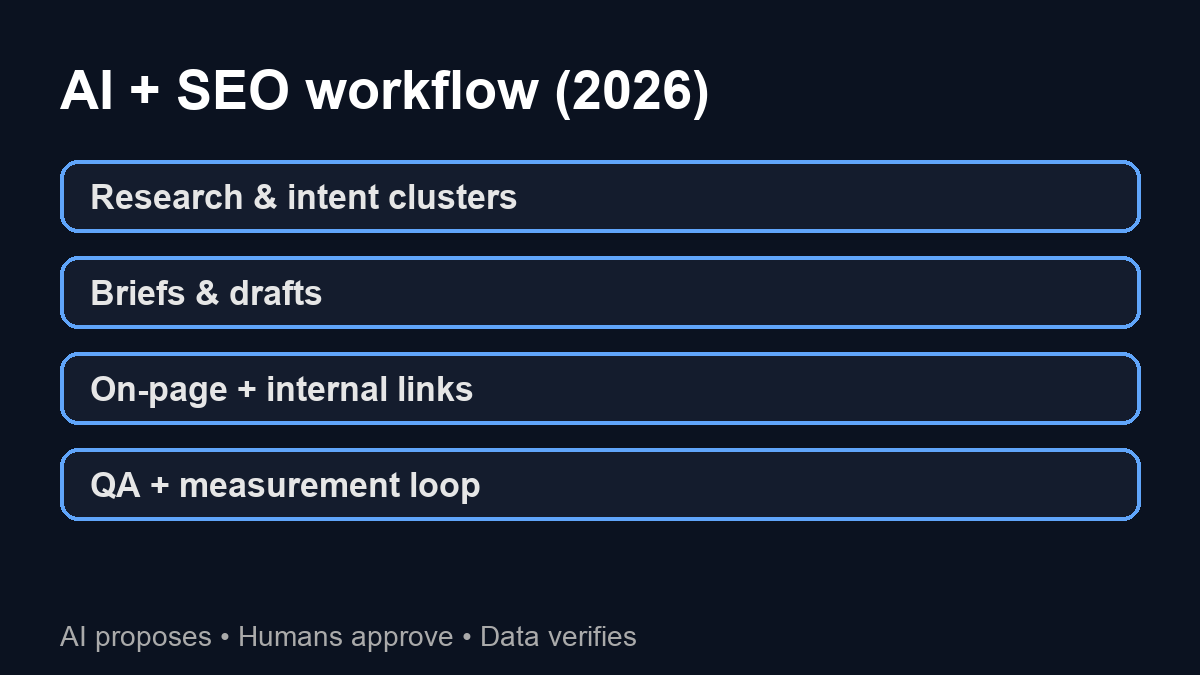
AI has changed SEO, but not in the way most people expected. It didn’t magically replace strategy, technical hygiene, or the need to understand customers. What it has done is speed up the unglamorous work: research, drafting, QA, internal linking, and analysis.
In 2026, the best SEO teams aren’t “letting AI do SEO”. They’re using AI to make their existing process more consistent, more scalable, and faster to iterate—while keeping humans in control of what matters: positioning, accuracy, and priorities.
This guide breaks down the most useful, real-world ways AI is being used to improve SEO today, and how you can adopt the same workflows without filling your site with generic content.
1) Faster keyword research and intent clustering (without the spreadsheet pain)
Keyword tools are great at producing lists, but humans still need to turn those lists into a plan. AI helps by translating raw keywords into intent clusters and content opportunities.
Typical workflow:
- Export queries (Search Console), keyword ideas (tools), and competitor terms.
- Ask AI to cluster by intent: informational, commercial investigation, transactional, navigational.
- For each cluster, output: the best page type (guide, category page, product page, comparison), primary query, secondary queries, and “what a good answer needs to include”.
Where AI really helps: capturing nuance in language. For example, “best”, “top”, “vs”, “alternatives”, “near me”, “how much”, “is it worth it” tend to signal different page formats and conversion expectations. AI can classify these patterns quickly, then you sanity-check with a quick SERP review.
2) Creating better content briefs (so writers don’t guess)
Most content underperforms because the brief is vague. AI makes it easier to generate a consistent brief template that every writer can follow.
A strong AI-assisted SEO brief includes:
- Primary intent + target query cluster
- Audience: who this is for (and who it is not for)
- Outline with H2/H3 suggestions
- Evidence requirements (examples, numbers, references, screenshots, policies)
- Internal links to include (and the anchor angle, not just the URL)
- CTA and next action (download, quote, booking, product selection)
AI can generate the skeleton. Your job is to add the differentiators: unique POV, proprietary expertise, product constraints, and real customer objections.
3) Drafting content at scale (without publishing thin AI pages)
AI is now routinely used to produce first drafts, especially for:
- FAQs and objection-handling sections on money pages
- Comparison pages (“X vs Y”, “best for”, “alternatives”)
- Process pages (“how it works”, “what to expect”)
- Long-form guides that require structure and consistency
The key is to avoid “AI autopilot”. A good team uses a human-in-the-loop approach:
- AI drafts using your brief and approved sources.
- A human editor verifies claims, removes fluff, and injects expertise.
- Final QA ensures the page is accurate, helpful, and aligned with brand voice.
Guardrail: never allow AI to invent product specs, legal claims, certifications, medical/financial advice, or performance guarantees. If a statement must be true, it must be sourced from your system of record (PIM/CRM/contracts/policies) or a reliable reference.
4) On-page optimisation that’s actually consistent
In most organisations, on-page optimisation is inconsistent: some pages get perfect headings and FAQs, others get nothing. AI helps apply a standard approach across your top pages.
High-impact areas AI can support:
- Title and heading rewrites: clearer, more intent-aligned, less keyword-stuffed.
- FAQ generation: based on real objections, search terms, and support tickets.
- Snippet-first formatting: TL;DR blocks, numbered steps, short definitions, comparison tables.
- Schema suggestions: Product/FAQ/HowTo/Organisation when it truly fits on-page content.
This is also where AI helps with language consistency. If you sell products with variants, AI can enforce naming conventions and ensure pages explain differences in the same way everywhere.
5) Internal linking at scale (one of the most underrated AI uses)
Internal linking is time-consuming and easy to deprioritise, but it’s one of the highest-leverage SEO activities. AI can:
- Suggest the 3–8 most relevant internal links per page.
- Propose natural anchor angles (not repetitive exact-match anchors).
- Identify orphaned content and missing hub pages.
A practical workflow is to feed AI your site’s URL list + page titles + short summaries, then ask it to propose a linking plan for your priority pages. A human then reviews for relevance and removes anything that doesn’t make user sense.
6) Technical SEO triage and QA
AI doesn’t “fix” technical SEO by itself, but it can dramatically speed up triage—turning noisy audit outputs into a prioritised action list.
Examples:
- Summarising crawl reports (what matters vs what’s noise)
- Grouping issues by template (PDPs, categories, blog posts)
- Drafting developer-ready tickets with reproduction steps
- Checking for common mistakes: canonical loops, redirect chains, blocked resources, thin templated content
Important: your final technical decisions should still rely on tools and logs (Search Console, server logs, crawlers). AI can help you move faster, but it shouldn’t be the evidence.
7) Measurement, reporting and “what should we do next?”
SEO reporting often fails because it’s either too high-level (“traffic up”) or too detailed (“200 keywords moved”). AI improves reporting by connecting signals to decisions.
A strong AI-assisted report answers:
- What changed? (traffic, impressions, clicks, rankings, conversions)
- Why did it change? (content shipped, technical fix, seasonality, SERP change, competitors)
- What’s the next best action? (top 3 tasks with expected impact)
You can also use AI to create weekly “exception alerts”: flag pages where clicks drop sharply, where top queries changed, or where the intent mix shifted. That makes SEO more like performance marketing—spotting issues quickly instead of waiting for a monthly report.
8) AI search, GEO, and why SEO content must be more extractable
As AI answers become more common, the win condition isn’t only “rank #1”. It’s also “be the source that gets cited”. This is where Generative Engine Optimisation (GEO) enters the conversation.
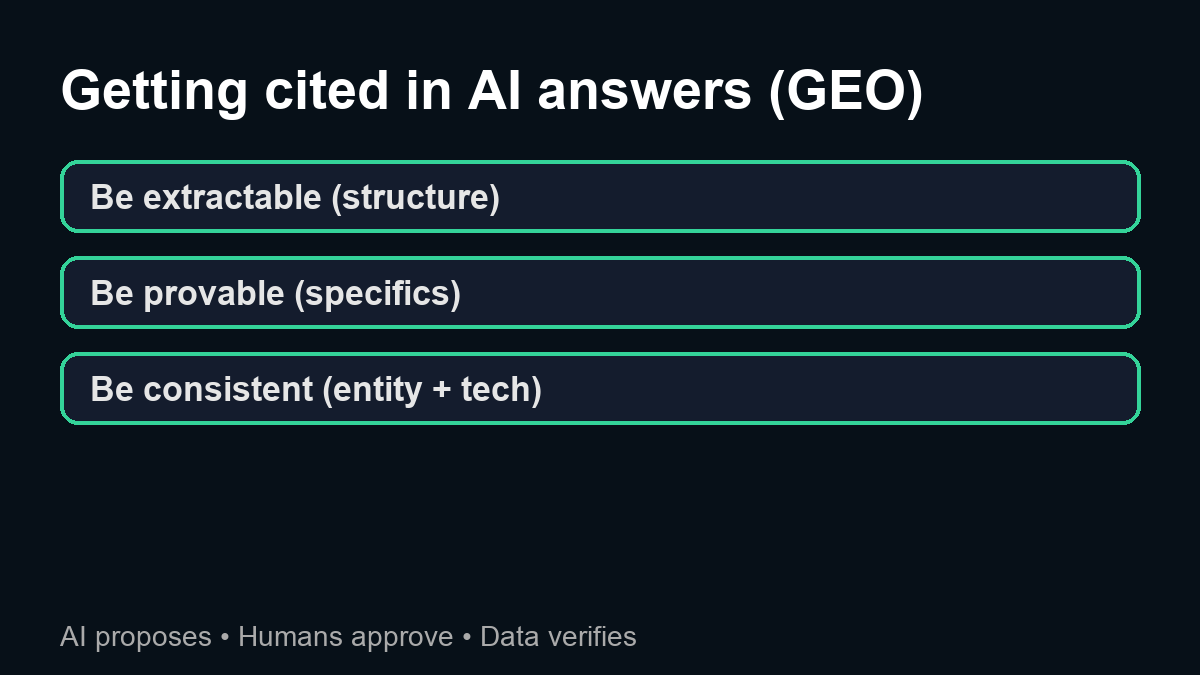
AI systems tend to cite content that is:
- Clear and structured: headings, concise definitions, lists, steps.
- Specific: constraints, numbers, edge cases, comparisons.
- Trustworthy: consistent brand/entity signals, stable URLs, transparent policies.
- Accessible: crawlable HTML, good internal linking, sensible canonicals.
AI helps here by creating snippet-ready blocks and by ensuring your pages answer questions directly. But again: the content must be true, and it must be based on what you can actually deliver.
9) The biggest risks (and how good teams avoid them)
AI can absolutely harm SEO if used lazily. The most common failure modes in 2026 are:
- Thin content at scale: lots of pages, little value, poor engagement signals.
- Hallucinated claims: incorrect facts that create trust and compliance problems.
- Brand dilution: generic tone, no point of view, no expertise.
- Over-automation: changing too many variables without learning what worked.
The fix is governance: templates, QA checklists, approved sources, and a clear policy on what AI is allowed to generate. If you treat AI like a junior assistant—fast, helpful, but not authoritative—you get the benefit without the downside.
10) A simple adoption plan (start small, then scale)
If you want to implement AI in your SEO workflow without disruption, start with a 2-week pilot:
- Pick 10 priority pages (highest revenue or highest opportunity).
- Use AI to produce: improved titles, a TL;DR block, 5 FAQs, and an internal linking plan.
- Ship changes and track performance for 14–21 days.
- Document the template (what worked, what didn’t, what to avoid).
- Roll out to the next 50 pages using the same rules.
This approach creates compounding wins: every iteration makes the process better, and every page becomes easier to improve.
Final thought
AI is improving SEO in 2026 by making teams faster and more consistent. But the competitive advantage still comes from the human layer: knowing your customers, having genuine expertise, and building pages that deserve to be referenced. Use AI to accelerate the work—then apply judgment to make the work worth reading.