
Most businesses do not fail with AI because the technology is weak. They fail because they try too much at once, pick the wrong first project, and never tie delivery to commercial outcomes.
If you want AI to improve your business over the next quarter, you need a practical 90-day roadmap: clear priorities, accountable owners, realistic timelines, and measurable KPIs.
This guide walks through a plain-English roadmap you can use immediately. It is designed for business owners and operational leaders who want useful progress rather than another strategy deck.
If you are unsure where your best opportunities sit, start with a focused AI audit first. It saves time by helping you prioritise what is worth doing now versus later.
What a 90-day AI roadmap should achieve
A good 90-day roadmap is not about “AI transformation”. It is about proving value in controlled, measurable steps.
By day 90, you should have:
- one to two live AI-assisted workflows,
- clear evidence of impact (time, quality, or revenue),
- defined governance and approval points,
- a realistic plan for what to scale next.
Anything beyond that is usually over-scoped for a first quarter.
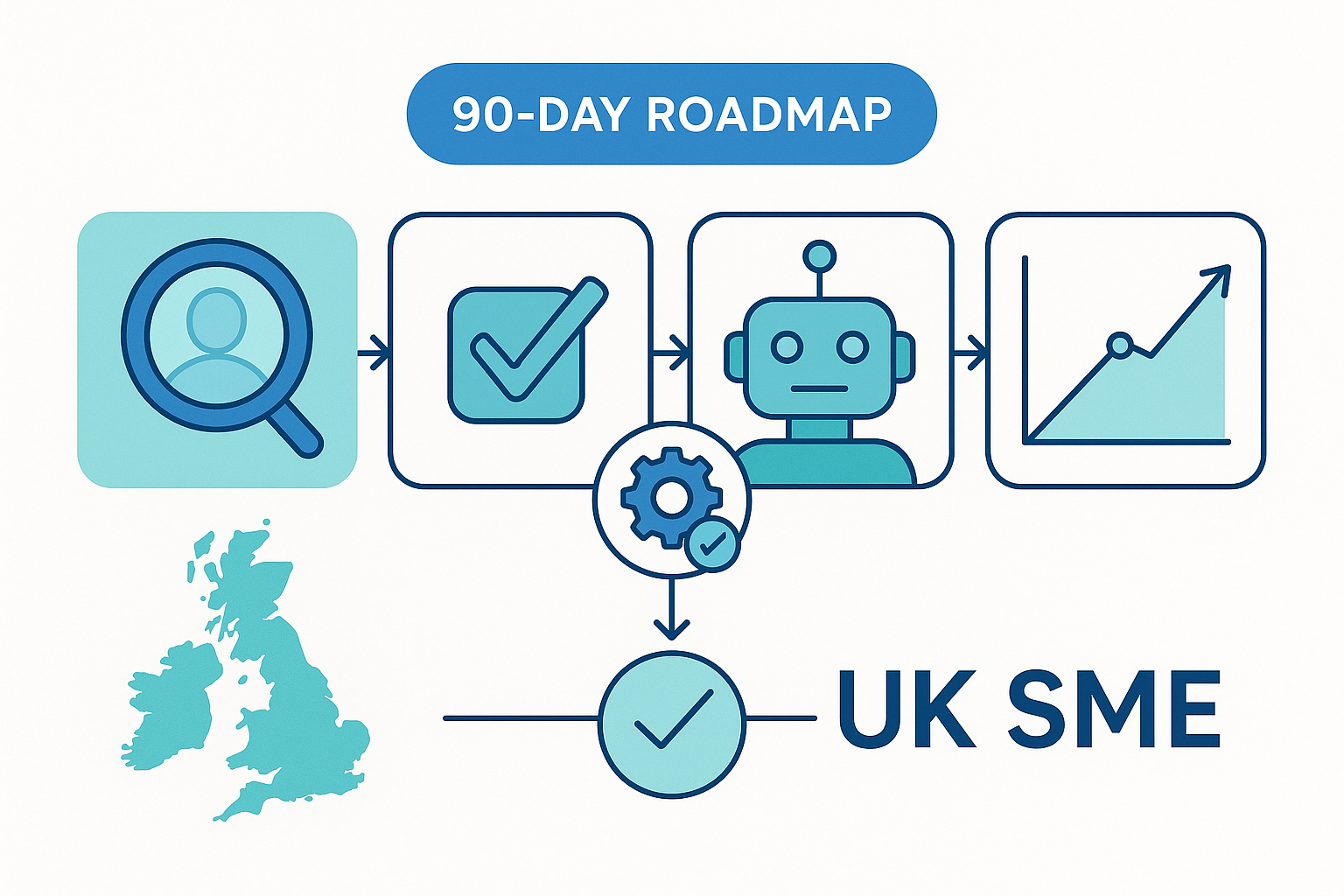
Phase 1 (Days 1–14): Discovery and prioritisation
The first two weeks are about choosing the right problems. Most costly mistakes happen here.
1) Define business outcomes first
Pick one to three outcomes you care about this quarter, such as:
- reduce proposal turnaround time,
- improve lead-to-meeting conversion,
- cut repetitive admin in operations.
Avoid vague targets like “be more innovative.”
2) Map your current workflow
Identify where delays, handoffs, and quality issues happen. You cannot automate what is not clearly defined.
3) Score use cases with a simple model
Use four criteria:
- Impact: commercial upside
- Effort: implementation complexity
- Risk: compliance/brand exposure
- Speed: time-to-value
Select one “efficiency win” and one “growth win” as your initial focus.
4) Assign accountable owners
Every use case needs a named owner. Shared accountability usually creates drift and delay.
Phase 2 (Days 15–45): Build and pilot
This phase is where you move from planning to execution, but still in a controlled test environment.
1) Build the smallest useful version
Do not build the final system first. Start with a thin, high-value version that can run in real workflow conditions.
2) Keep human-in-the-loop controls
For client-facing, financial, or sensitive tasks, require human approval before output is sent or actioned.
3) Define quality checks early
Track where outputs fail and why. This is how prompts, process steps, and controls improve quickly.
4) Run weekly pilot reviews
Every week, review:
- what worked,
- what failed,
- what to refine next.
If you need cross-system implementation support, a scoped AI development services phase can connect outputs directly into your operating stack.
Phase 3 (Days 46–75): Stabilise and operationalise
At this stage, your goal is consistency, not novelty.
1) Document the operating model
Create simple process notes covering:
- inputs required,
- approval checkpoints,
- fallback actions when output quality drops.
2) Train the teams using it daily
Short, role-specific training works best. Avoid broad “AI awareness” sessions without workflow context.
3) Improve integration reliability
Reduce manual copy/paste and improve handoffs into CRM, project management, and reporting tools.
4) Tighten governance
Apply clear boundaries around data usage, approvals, and monitoring. For UK organisations, align controls with practical standards such as ICO AI guidance.
Phase 4 (Days 76–90): Measure, decide, scale
By now, you should have enough evidence to make commercial decisions.
1) Review KPI performance
Compare before/after metrics for speed, quality, and business impact.
2) Decide what to do with each use case
- Scale: proven value and stable quality
- Adjust: promising but inconsistent
- Stop: low impact or high friction
3) Build the next-quarter backlog
Carry forward only what supports business goals and available team capacity.
Roadmap scorecard: what to track every fortnight
| Category | Metric | Why it matters |
|---|---|---|
| Productivity | Cycle time per workflow | Shows if delivery is actually getting faster |
| Quality | Error/rework rate | Prevents “faster but worse” outcomes |
| Commercial | Revenue impact or hours saved | Ties AI to outcomes leadership values |
| Adoption | Active usage by target team | Confirms this is an operating habit, not a one-off test |

Common 90-day roadmap mistakes to avoid
- Too many projects at once: causes context switching and poor delivery.
- No baseline metrics: makes ROI impossible to prove.
- Weak ownership: nobody drives progress when blockers appear.
- No review rhythm: issues persist because nobody checks quality consistently.
- Tool-first decisions: software gets purchased before business need is clear.
These are fixable with a practical structure and clear accountability.
How this roadmap works for non-technical teams
You do not need an in-house AI engineering team to start. Most SMEs succeed by combining operational ownership with a practical external partner and simple governance.
The key is to keep language and processes accessible:
- plain-English documentation,
- role-based responsibilities,
- simple reporting,
- and fast feedback loops.
If you need end-to-end support, this can sit inside a broader AI services programme that moves from roadmap to implementation without handoff gaps.
Example roadmap by department (so everyone knows their role)
One reason roadmaps fail is that every team assumes someone else owns delivery. A better model is to assign practical responsibilities by department.
| Department | Primary ownership in the first 90 days | Typical deliverable |
|---|---|---|
| Leadership | Set commercial outcomes and approve priorities | Quarter goal sheet + review cadence |
| Operations | Map workflows and define process checkpoints | Current-state process maps |
| Marketing/Sales | Pilot growth use cases with clear KPIs | Use-case playbook + weekly performance notes |
| Delivery/Service | Test quality and handoff reliability | Quality checklist + escalation rules |
| Compliance/Finance | Set risk boundaries and audit expectations | Approval matrix + policy summary |
When each team has a clear role, roadmap execution speeds up and “ownership drift” drops significantly.
A realistic weekly cadence for the quarter
Roadmaps improve when teams follow a predictable rhythm. You do not need long meetings. You need short, focused check-ins.
- Monday (15 mins): this week’s priority outcomes and blockers.
- Wednesday (20 mins): quality review, issue triage, and quick fixes.
- Friday (25 mins): KPI update, lessons learned, and next-week decisions.
This cadence helps teams catch failure patterns early while keeping momentum high.
Budgeting your first 90 days without overcommitting
Most teams overspend when they commit to full-scale implementation before proving value. A staged budget is usually safer:
- Discovery budget: small, fixed scope (problem definition and prioritisation).
- Pilot budget: focused on one to two use cases with measurable outcomes.
- Scale budget: released only if pilot KPI thresholds are met.
This approach makes roadmap investment easier to defend with finance and leadership stakeholders.
Decision gates to include at day 30, 60, and 90
Do not wait until the end of the quarter to decide whether a use case is working.
Day 30 gate
- Is implementation on track?
- Are owners active and blockers manageable?
- Do quality checks show acceptable baseline output?
Day 60 gate
- Do early KPI signals suggest commercial value?
- Is adoption happening beyond the original pilot team?
- Are any risks increasing faster than expected?
Day 90 gate
- Did outcomes improve versus baseline?
- Should this use case scale, adjust, or stop?
- What enters the next-quarter roadmap?
These decision gates reduce sunk-cost behaviour and keep execution disciplined.
How to communicate roadmap progress to your team
Internal communication often gets ignored in AI projects, but it directly affects adoption. Keep updates short and practical:
- What changed this week
- What improved (with one metric)
- What still needs human review
- What teams should do differently next week
When people understand what is changing and why, adoption becomes far easier.
One-page roadmap template (quick start)
If you need to start quickly, keep your first roadmap to one page: objectives, two use cases, owners, milestones, KPI baseline, review dates, and decision gates. One-page roadmaps are easier to execute than long strategy documents and much easier to keep updated in real time.
FAQ
How detailed should a 90-day AI roadmap be?
Detailed enough to define outcomes, owners, milestones, and controls, but simple enough that teams can execute it weekly without confusion.
Should we prioritise one large project or multiple small pilots?
For most organisations, one to two focused pilots are better in the first 90 days. They create evidence faster and reduce delivery risk.
What if our data is not perfect yet?
You do not need perfect data to start. You do need data that is reliable enough for the selected use case and clear remediation steps for known gaps.
How often should leadership review progress?
Fortnightly is usually ideal for roadmap governance: frequent enough to correct quickly, but not so frequent it disrupts delivery.
How do we stop AI projects becoming endless experiments?
Use explicit go/adjust/stop decision gates tied to KPI outcomes at set checkpoints, especially around day 45 and day 90.
Next step
If you want a 90-day roadmap that produces measurable results, start with one efficiency win and one growth win, then execute in controlled phases. If you want help building and running that plan, contact us and we can map your best first quarter approach.